
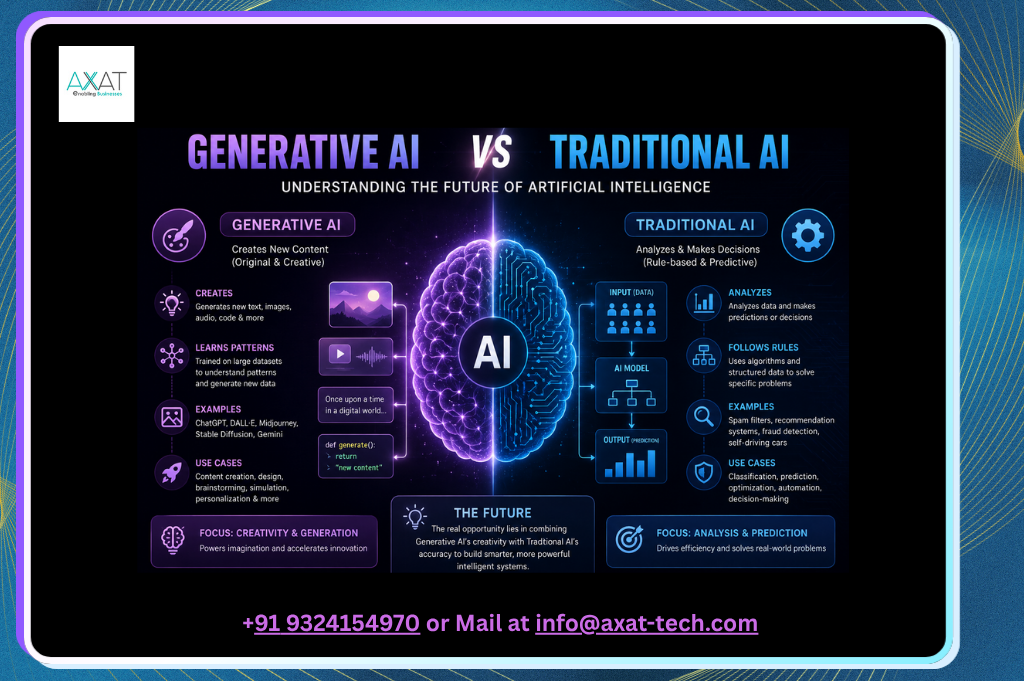
Generative AI vs Traditional AI: Understanding the Future of Artificial Intelligence
Artificial intelligence has rapidly transformed from a futuristic concept into a practical technology that influences almost every aspect of our daily lives. Whether you're using a recommendation engine on a streaming platform, receiving fraud alerts from your bank, or chatting with an AI assistant, you're interacting with AI in one form or another. Yet, as AI continues to evolve, a significant distinction has emerged between traditional AI and generative AI.
The rise of tools like ChatGPT, Gemini, Claude, and Midjourney has pushed generative AI into mainstream discussions. Businesses, governments, and consumers are increasingly investing in these technologies. According to recent studies, generative AI adoption among U.S. adults surpassed 54% in 2025, showing one of the fastest technology adoption rates in modern history.
But what exactly separates generative AI from traditional AI? Are they competitors, or do they complement each other? Understanding these differences is crucial for businesses, professionals, and anyone interested in the future of technology.
What Is Artificial Intelligence?
'Artificial intelligence' refers to computer systems designed to perform tasks that typically require human intelligence. These tasks include learning, problem-solving, decision-making, pattern recognition, language understanding, and prediction. AI isn't a single technology but rather a broad field encompassing machine learning, deep learning, natural language processing, computer vision, and robotics.
Think of AI as a massive toolbox. Traditional AI represents the classic tools that perform highly specialised tasks with remarkable efficiency. Generative AI, on the other hand, introduces entirely new tools capable of creating original content, conversations, images, videos, and even software code. Both belong to the same family but serve different purposes.
The Evolution of AI Technologies
The journey of AI began with rule-based systems that followed predefined instructions. Over time, machine learning enabled systems to learn patterns from data instead of relying solely on programmed rules. This advancement paved the way for predictive analytics, recommendation engines, and intelligent automation.
The launch of large language models dramatically changed the landscape. Generative AI emerged as a technology capable of producing human-like outputs rather than merely analysing data. This shift transformed AI from a decision-support tool into a content-generation engine, expanding its potential applications across industries. Adoption rates now exceed those seen during the early years of personal computers and the commercial internet.
What Is Traditional AI?
'Traditional AI' refers to systems designed to analyse information, identify patterns, make predictions, and automate specific tasks. Its primary purpose is to solve well-defined problems using structured data and predetermined objectives.
Unlike generative AI, traditional AI does not create entirely new content. Instead, it focuses on classification, forecasting, optimisation, and decision-making. When a bank detects suspicious transactions or an online retailer recommends products based on previous purchases, traditional AI is usually working behind the scenes.
How Traditional AI Works
Traditional AI relies on algorithms trained using historical datasets. The system identifies relationships within the data and applies those patterns to future situations. For example, a spam filter learns which email characteristics indicate spam and then classifies incoming emails accordingly.
Most traditional AI systems are highly specialised. They excel within clearly defined boundaries but struggle when confronted with unfamiliar situations. Their strength lies in precision and consistency rather than creativity.
Common Examples of Traditional AI
Some familiar examples include:
|
Application |
Traditional AI Function |
|
Fraud Detection |
Identifies suspicious transactions |
|
Recommendation Systems |
Suggests products or content |
|
Predictive Maintenance |
Forecasts equipment failures |
|
Credit Scoring |
Evaluates lending risk |
|
Navigation Systems |
Optimizes routes and traffic predictions |
These applications demonstrate how traditional AI helps organisations improve efficiency, reduce costs, and make better decisions.
What Is Generative AI?
Generative AI is a category of artificial intelligence designed to create new content based on patterns learned from massive datasets. Instead of simply analysing information, it generates text, images, videos, audio, software code, and other forms of content.
This technology represents one of the most significant advancements in modern computing. Rather than answering questions with fixed responses, generative AI produces original outputs that closely resemble human-created content. This capability has revolutionised industries ranging from marketing and education to software development and entertainment.
How Generative AI Creates Content
Generative AI models are trained on enormous amounts of data collected from books, websites, images, videos, and other digital sources. Through deep learning techniques, particularly transformer architectures, these models learn patterns, structures, and relationships within the data.
When a user submits a prompt, the model predicts and generates the most relevant response based on its training. It's similar to how a skilled musician improvises during a performance. The musician draws upon years of experience, while the AI draws upon billions of data points.
Popular Generative AI Models
Several platforms have become household names:
-
ChatGPT
-
Gemini
-
Claude
-
Midjourney
-
DALL-E
-
Stable Diffusion
-
GitHub Copilot
These systems demonstrate the broad capabilities of generative AI, from writing articles and generating images to assisting with software development.
Generative AI vs Traditional AI: Core Differences
Understanding the distinction between these technologies becomes easier when comparing their core characteristics.
|
Feature |
Traditional AI |
Generative AI |
|
Purpose |
Analyse and predict |
Create new content |
|
Output |
Classifications and decisions |
Text, images, videos, code |
|
Data Type |
Mostly structured data |
Structured and unstructured data |
|
Creativity |
Limited |
High |
|
Human Interaction |
Task-focused |
Conversational |
|
Learning Scope |
Specialized tasks |
Broad contextual understanding |
Data Processing Approach
Traditional AI typically works with structured datasets such as spreadsheets, databases, and transaction records. It focuses on extracting insights and identifying patterns.
Generative AI processes both structured and unstructured information, including text documents, images, videos, and audio recordings. This broader data exposure enables more flexible outputs and richer contextual understanding.
Output Generation
The most obvious difference lies in output. Traditional AI predicts outcomes, while generative AI creates entirely new content.
For example, a traditional system might identify whether an email is spam. A generative system could write an entire email from scratch based on a brief instruction.
Learning and Adaptability
Traditional AI systems often require retraining when new requirements emerge. Generative AI models demonstrate greater adaptability because they learn generalised patterns across vast datasets.
This flexibility allows generative models to perform multiple tasks using the same underlying architecture, including summarisation, translation, coding, and creative writing.
Human Interaction
Generative AI offers a more natural conversational experience. Users communicate through prompts and receive detailed responses. Traditional AI interactions are usually invisible, occurring behind applications and workflows.
Key Advantages of Traditional AI
Traditional AI remains essential despite the excitement surrounding generative AI. Many business-critical applications depend on its reliability and precision.
Accuracy and Reliability
Traditional AI excels in situations where accuracy matters more than creativity. Financial institutions, healthcare providers, and manufacturing companies often rely on these systems because predictable outcomes are crucial.
For example, a predictive maintenance system monitoring industrial equipment must deliver accurate forecasts rather than imaginative suggestions. Traditional AI provides consistent performance because it operates within clearly defined parameters.
Organisations also appreciate its transparency. Since traditional models often follow structured rules and objectives, their decisions can be easier to explain and audit compared to large generative models.
Key Advantages of Generative AI
Generative AI introduces capabilities that were previously impossible or extremely costly to achieve.
Creativity and Innovation
The greatest strength of generative AI lies in its ability to create. Businesses can produce marketing content, customer support responses, product descriptions, training materials, and software code at unprecedented speeds.
Recent studies indicate that generative AI usage continues to rise rapidly across workplaces and consumer applications. Organisations increasingly view these tools as productivity enhancers capable of reducing repetitive work and accelerating innovation.
Generative AI also supports brainstorming and ideation. Rather than replacing human creativity, it often acts as a collaborative partner, helping individuals explore possibilities and overcome creative blocks.
Industry Applications
Healthcare
Healthcare organizations use both Traditional AI and Generative AI for different purposes. Traditional AI excels at medical image analysis, patient risk prediction, and disease detection. Generative AI supports clinical documentation, patient communication, and research summarization.
Doctors can leverage Generative AI to draft reports while relying on Traditional AI for diagnostic support. Together, these technologies improve efficiency without compromising accuracy.
Finance
Financial institutions have long depended on Traditional AI for fraud detection, credit scoring, and algorithmic trading. Generative AI now assists with customer service, regulatory reporting, and financial analysis.
The combination allows banks to automate routine interactions while maintaining robust risk management frameworks.
Marketing and Content Creation
Marketing is arguably the industry most transformed by Generative AI. Companies use it to create blog posts, social media content, advertising copy, email campaigns, and personalized customer experiences.
Traditional AI still plays an important role by analyzing customer behavior, segmenting audiences, and measuring campaign performance. The creative power of Generative AI combined with the analytical strength of Traditional AI creates a highly effective marketing ecosystem.
Manufacturing
Manufacturing relies heavily on Traditional AI for predictive maintenance, quality control, and supply chain optimization. Generative AI contributes by generating technical documentation, employee training materials, and engineering design concepts.
The result is a more efficient production environment supported by both analytical precision and creative problem-solving.
Challenges and Limitations
Neither AI approach is perfect. Traditional AI struggles with flexibility and often requires extensive domain-specific training. It performs exceptionally within predefined boundaries but lacks the adaptability needed for open-ended tasks.
Generative AI faces different challenges. Hallucinations, bias, copyright concerns, security risks, and high computational costs remain significant issues. Industry research highlights that many organizations continue to struggle with implementation and governance despite rapid adoption rates. Some studies suggest that a large percentage of pilot projects fail to deliver expected business outcomes due to poor integration strategies and unrealistic expectations.
Privacy concerns also remain a major consideration. Organizations must establish clear governance frameworks to ensure responsible AI usage. Human oversight continues to play a critical role in maintaining quality, compliance, and ethical standards.
The Future of AI
The future isn't likely to be Generative AI replacing Traditional AI. Instead, both technologies will increasingly work together.
Traditional AI will continue handling prediction, optimization, and decision-making tasks. Generative AI will focus on communication, content creation, and human interaction. Businesses that successfully integrate both approaches will gain significant competitive advantages.
Global adoption continues to accelerate. Research indicates that approximately one in six people worldwide now use generative AI tools, while enterprise investment remains strong across multiple industries.
At the same time, organizations are learning that successful AI implementation requires more than technology. Training, governance, process redesign, and human collaboration are becoming equally important. The most effective AI strategies combine automation with human expertise rather than attempting complete replacement.
As AI evolves, the distinction between Traditional AI and Generative AI may become less visible to users. Future systems will likely combine prediction, reasoning, and content generation within unified platforms capable of solving increasingly complex problems.
Conclusion
The debate between Generative AI vs Traditional AI isn't about choosing one over the other. Each serves a unique purpose within the broader artificial intelligence ecosystem.
Traditional AI remains the foundation of predictive analytics, automation, and decision-making. It delivers accuracy, consistency, and reliability for mission-critical applications. Generative AI introduces creativity, adaptability, and conversational capabilities that expand what machines can accomplish.
Organizations that understand these differences can make smarter technology investments and build more effective AI strategies. As adoption continues to grow worldwide, the future belongs not to one type of AI but to the powerful combination of both. Together, they are reshaping industries, redefining work, and creating opportunities that were unimaginable just a few years ago.
FAQs
1. What is the main difference between Generative AI and Traditional AI?
Traditional AI analyzes data and makes predictions, while Generative AI creates new content such as text, images, videos, and code.
2. Is ChatGPT an example of Generative AI?
Yes. ChatGPT is a Generative AI model that produces human-like text responses based on user prompts.
3. Which is better for businesses: Traditional AI or Generative AI?
Neither is universally better. Traditional AI excels at prediction and automation, while Generative AI is ideal for content creation, communication, and knowledge assistance.
4. Can Generative AI replace Traditional AI?
No. Generative AI complements Traditional AI rather than replacing it. Most organizations benefit from using both technologies together.
5. What industries benefit the most from Generative AI?
Marketing, healthcare, education, finance, software development, entertainment, and customer service are among the industries seeing the greatest benefits from Generative AI.